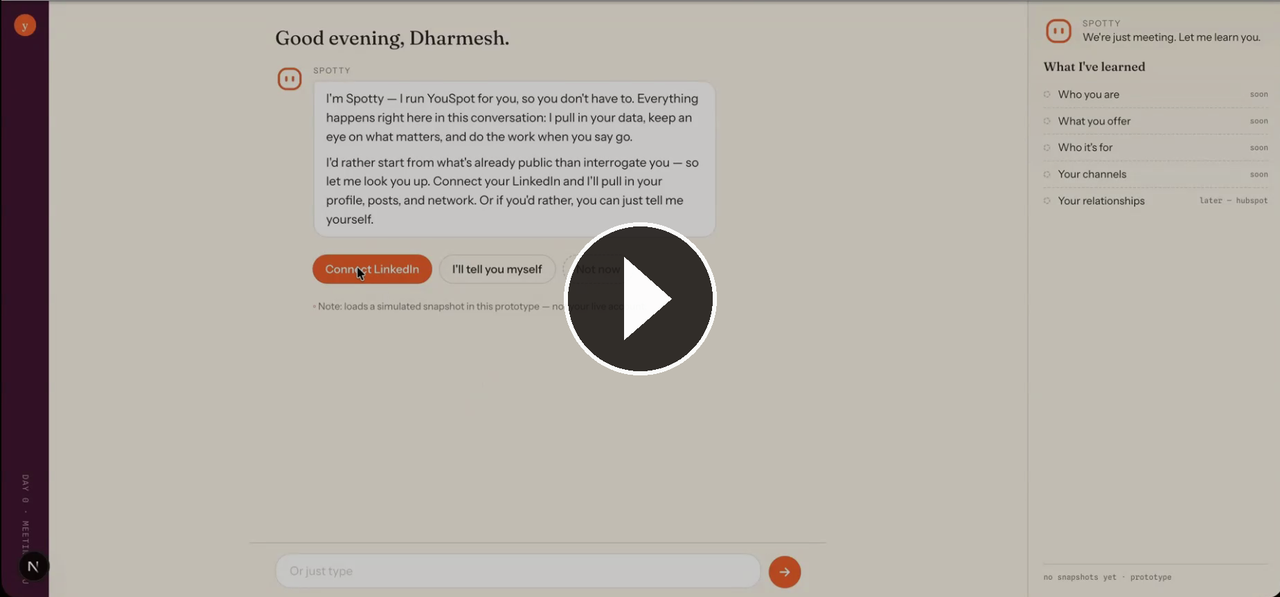
When Dharmesh Shah announced YouSpot, an AI-native CRM for one-person companies, I thought: finally a CRM I can use. I started using it. A setup checklist, and then: here is the product, figure out how it works. I still felt overwhelmed. The AI-native CRM turned out to be an old-school CRM with a chat feature.
YouSpot is just an example. Every product works this way. Everyone expects me to do the hard work of learning how to use their product. Bigger companies have complete tutorials, wikis, knowledge bases, YouTube channels about how to use their product. They spend so much money explaining their product to people. It's crazy.
Maybe I notice it more because Claude handles most of this for me nowadays. It creates my Notion pages, my Google Docs, my email sequences in Kit. I rarely open those tools myself. I say what I want.
So I thought: what if we push that to the limit? What if the AI of a product handled all the complexity of that product, and I could just do stuff? It does the onboarding. It pulls in the right context at the right time. I don't have to think about weird object structures. I don't have to think about how to map relationships between everything. I say what I need, and the AI of that product figures out how and sets it up.
So now I had this in my head. And Dharmesh builds YouSpot in public: his welcome email says to just write to him if you have feedback. But how do I make this clear to someone who is not in my head? It sounds very abstract. The solution was simple: build it. So I built a prototype, with YouSpot as the example, and sent Dharmesh a login. Not because I expect anything back. I didn't want to just complain.
Two minutes, no sound. Watch the walkthrough on LinkedIn. It runs on Dharmesh's public data, so in the demo the agent treats me as him. No live connectors, nothing sends.
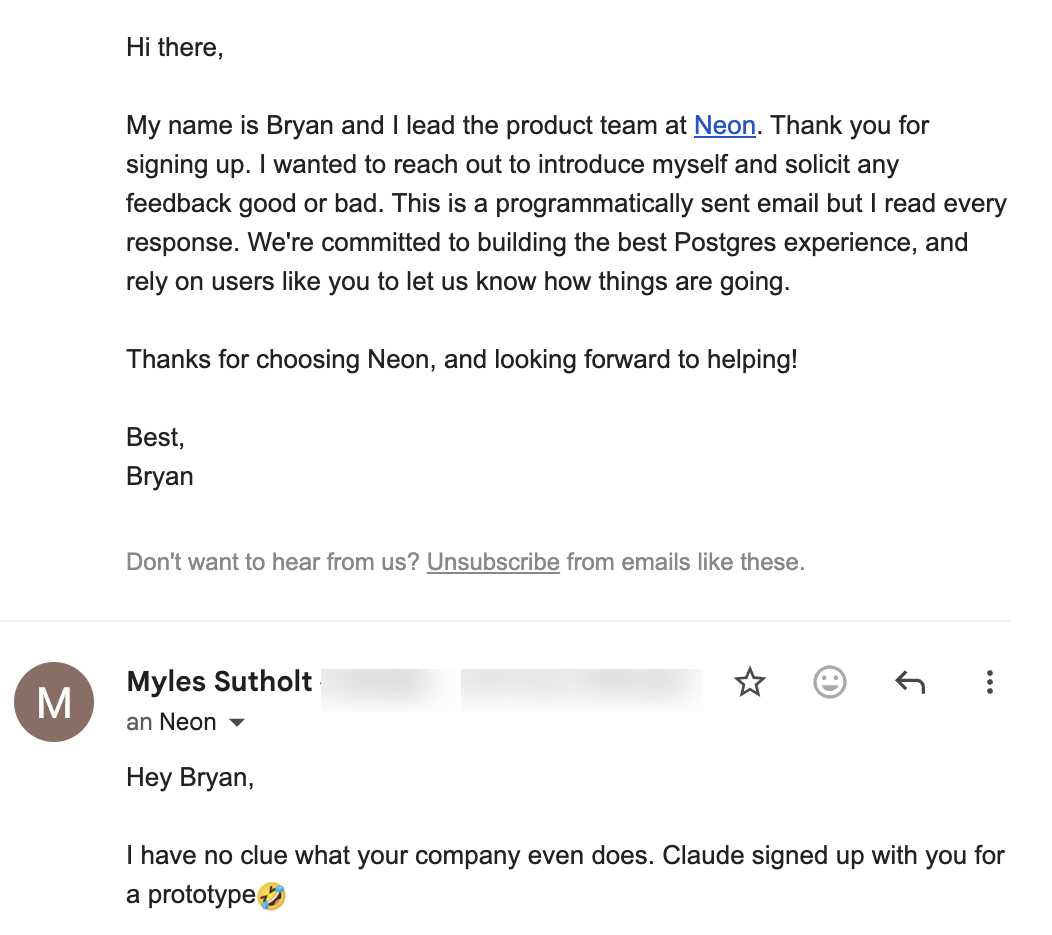
Funny enough, I had Claude set up the server environment etc. Because I wanted to show it to Dharmesh, it had to be on the internet. It signed me up for the tools it needed with my email address, set up accounts and environments, connected everything and deployed it. I am signed up for tools I didn't know existed. I did nothing.
Still no idea what they are actually doing :D
Onboarding without the thousand questions
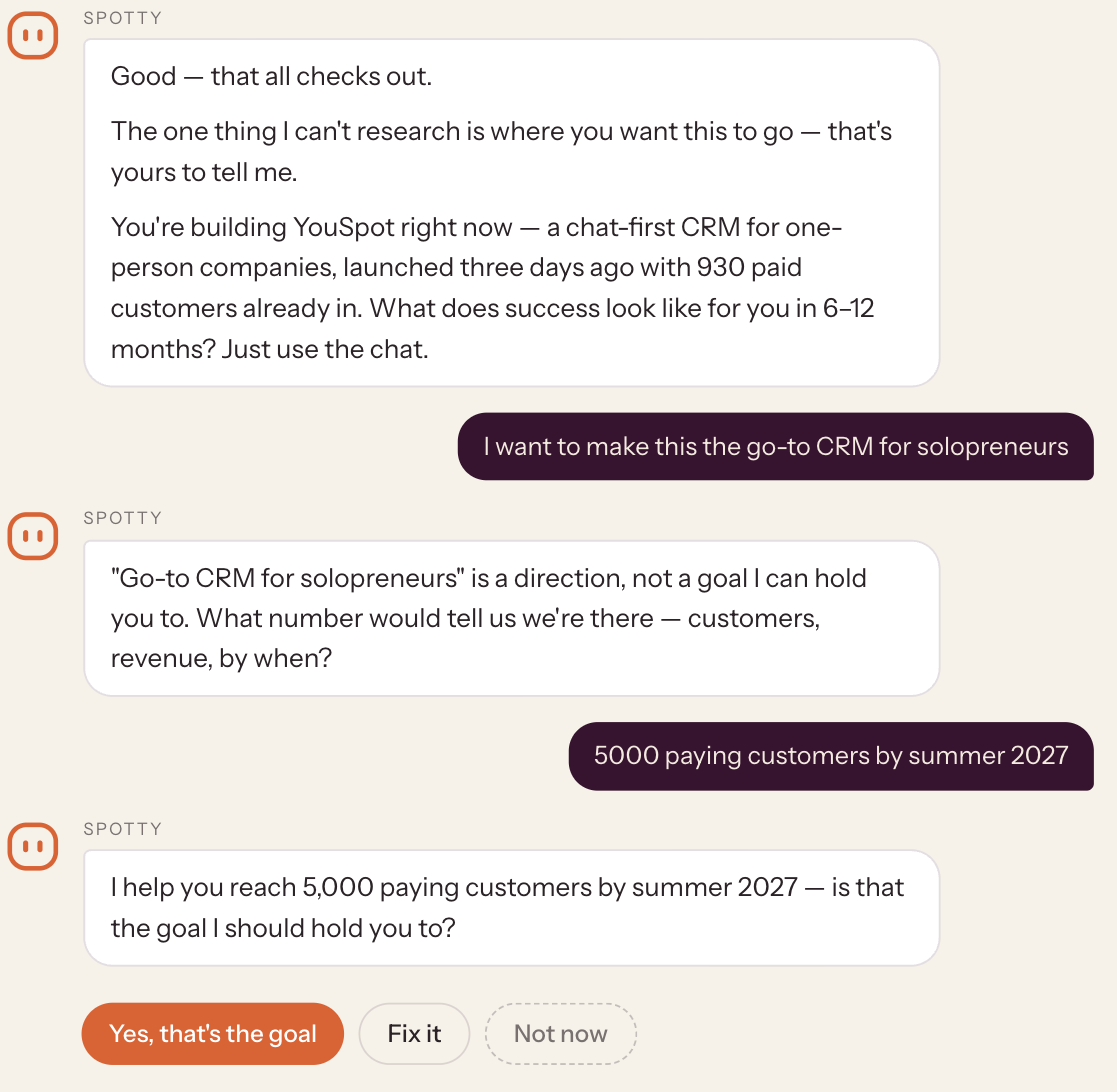
Instead of asking me a thousand questions, Spotty, the agent in the prototype, goes and searches for the answers. Then it asks me about what it is missing. And it evaluates the answers I give. For example, the one thing it couldn't find out was the goal: where YouSpot should be in twelve months. I gave it a vague answer. It pushed back: that is a direction, not a goal it can hold me to.
Playing Dharmesh, I answered "the go-to CRM for solopreneurs". Spotty: a direction, not a goal it can hold me to.
That is a fundamentally different way of onboarding people.
It finds what needs my focus
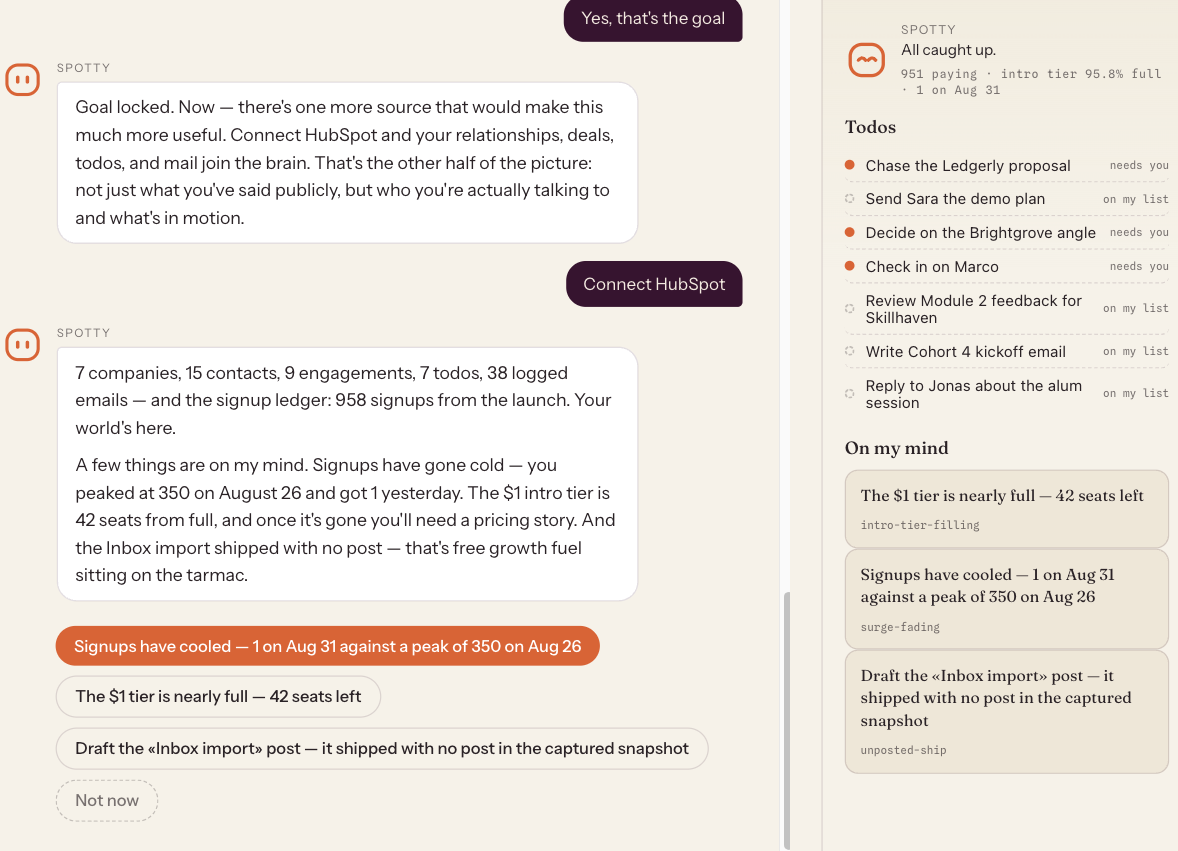
In a normal CRM, I look at things, click through tabs, and decide what to focus on. Here the AI looks at all of it and tells me what needs my attention right now, and asks whether I want to work on it together. I don't find the data. It finds me.
What Spotty had on its mind after reading the CRM. Snapshot data, not a live account.
It keeps my work separate, without me doing anything
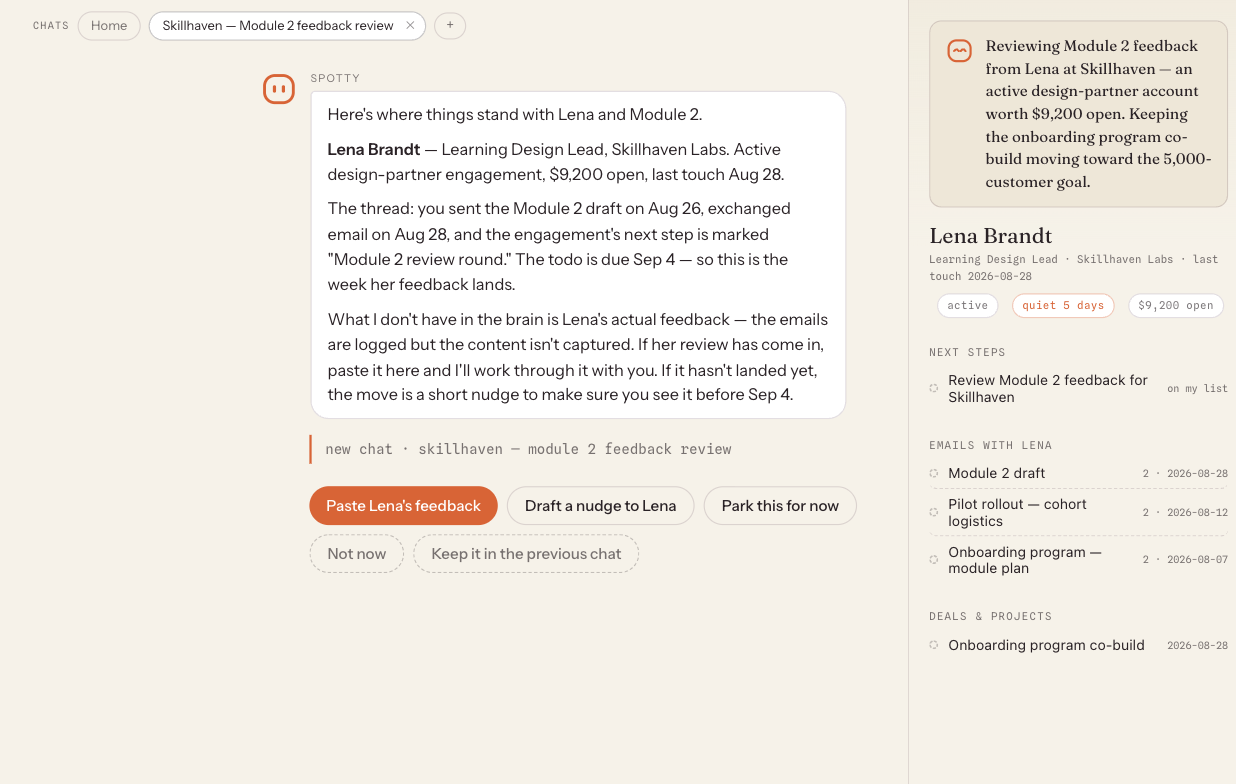
When I move to a different task, Spotty notices and opens a new chat for it. Tasks stay genuinely separated. I can go back to the old chat and continue, or close it. I have never seen anyone do this. Even Claude doesn't. It's strange, because everyone has these context problems.
Spotty giving the new task its own chat and pulling in what that job needs.
It learns how I decide
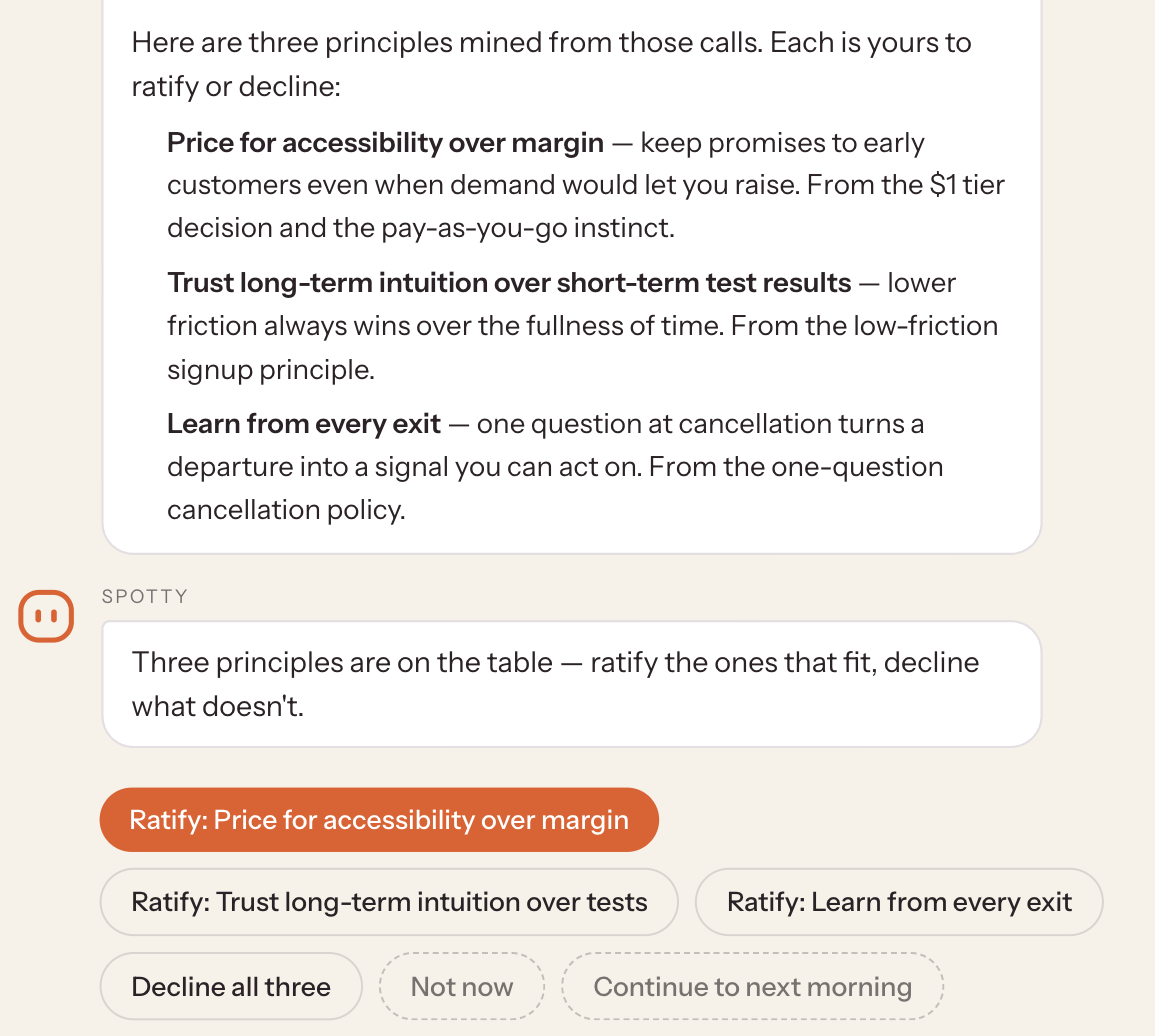
Every real call I make in conversation, it logs. Pricing, positioning, who to chase, what to drop. It reads the decision back to me so I can correct it, and it keeps the history when I do. It even reads my own posts for the calls I have already made and asks me to confirm the real ones and kill the rest.
Every once in a while it will propose the principles behind the themes in my decisions, each one citing the decisions it came from. I approve or decline. Only what I approve shapes what it proposes next.
Playing Dharmesh, I asked what Spotty had learned about how I decide. Each principle cites the decisions it was mined from. I approve or decline.
The same pattern runs through the small things. "Keep an eye on Mira" becomes a standing job, and the morning brings what it found. A pasted note gets filed, and it tells me where.