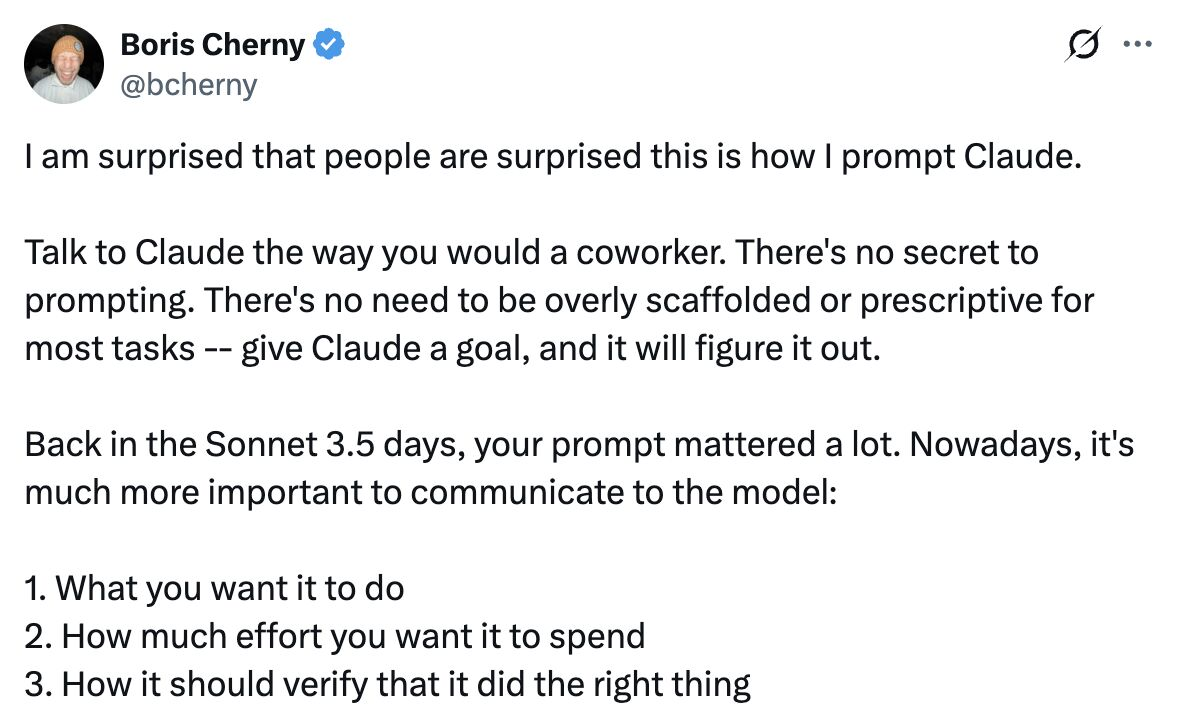
At the end of every cohort there's one session where I just show people how I use AI, and where I think they should be heading. In the last one, I put it like this:
Don't think about prompting so much. You just tell it: this is our current state, use that context to make decisions. What you want is to reach this goal, and here's how you evaluate that you reached it. That's basically it. Three sentences.
It works for me because my AI has something to draw from: guidelines, rules and knowledge about my work that I've built up over time. Without that, none of this works. You get a guess.
Here are Boris's three points, one at a time, with how they look in my work.
What you want, not how
I wrote this newsletter with my AI. In one draft, my flight story wasn't precise enough, so I provided feedback for a correction. This is part of it, exactly as I sent it:
And what you want, I think that needs to be a bit more precise. Like, what I gave my AI was the miles I had for all the loyalty programs and how much I had where. And I told it, on these dates, I want to fly back. Figure out how I can do that. And it found one, right? […]
No template, no clever wording. It's how I'd talk to a colleague. And the story in it is the point: finding the way was my AI's job. Mine was to say where I wanted to go.
How much effort
A coworker would ask how much time to spend on something. Your AI doesn't ask. Left alone, it goes really fast into execution mode, and then you get really sloppy work.
So I tell it. When something goes out to someone and really matters, I tell my AI to make very, very sure everything is checked. That one sentence carries a lot, because of what's behind it: rules, frameworks and protocols I've defined. When I say it, my AI goes back to my verification protocol and runs it, in a loop that keeps going without me, until every fact is checked and there's no AI slop left. One of those runs went through the whole night.
That costs tokens like crazy, so I don't do it for everything. Other times I'm lean: alright, we'll just work with whatever you give me. Boris wrote the first kind straight into his example: "Make it really good, use lots of tokens and iterate till you're proud of it."
How it knows it's done
Left alone, your AI also decides for itself when it's finished. So tell it where the finish line is.
Sometimes the finish line is a test. Say you want it to rank your to-dos every morning. Rank them yourself first and write down why. Then let your AI do the same, and compare. Wherever you differ, you've found something it doesn't know about your priorities. That comparison becomes the test it checks itself against.
Sometimes it's an end point. For the flight, the finish line is: you've explored every feasible option. Every connection that gets me home within about 14 hours, layovers included, across all my loyalty programmes, their partners and the transfers between them. Found something and told me? Done. Tried all of it and found nothing? Also done.
Defining that is the hard part, and nobody can do it for you.
The message itself stays plain in all three. What makes it work is everything your AI has to go on. If you want to see what that looks like, I'll show a working setup in a free session on November 6.