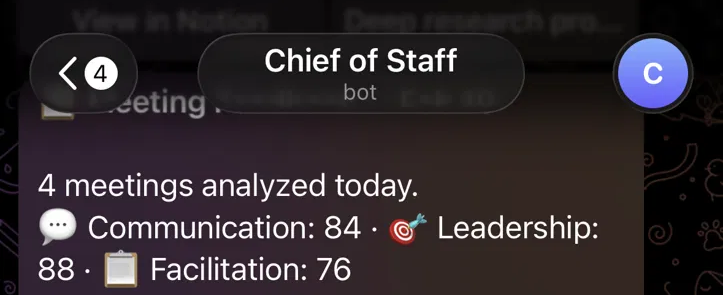
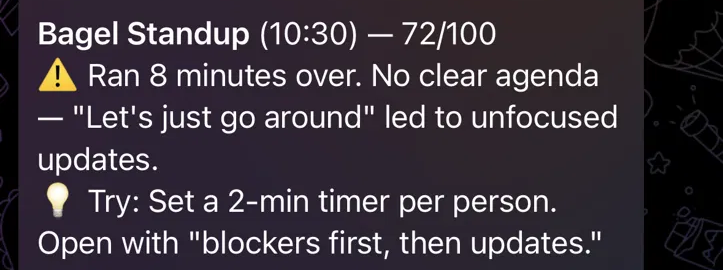
And because every score also goes into a table, not just an email, I can look back over a couple of months and see where I ended up and how I improved.
How it knows what good looks like
The screenshots come from my own setup, which runs automatically. The meeting coach I give away is the core of it: you give it a meeting transcript, and it writes you a report and keeps a log. This only works if it judges you by your situation, not by a generic idea of a good meeting. So here is how it makes sure it judges you properly, because that is where the real work is.
Two files do most of the work. One is about you. The other is about how to judge.
The first is your profile, built once: who you are, what you're working on, your meeting types and your role in each, the people you meet and your relationship to each of them, and what good looks like for you right now. It drafts most of that from your first transcript.
Two things in it, it will never guess: who the people are to you, and what your role was in the meeting. Without those, it doesn't coach at all. A guessed profile produces feedback that is confident, specific, well-argued and wrong, which is worse than nothing, because it sounds like it knows. The third thing, what good would have looked like, it asks for too. If you haven't told it, it still scores, but against a generic standard for that kind of meeting, and it says so every time.
Why so strict about the relationship? Because it sets the standard. With your manager, good communication is concise and comes with a solution. With someone who reports to you, the same behaviour is bad: good there is listening first and not solving it for them. Same act, opposite verdict. So a 1:1 with someone who reports to you is judged on how well you coached them, one with your manager on how you communicated upward, one with a peer on whether you built alignment, and a group meeting on how well the meeting ran.
The second file is the rubric, the rules for judging. Your role decides what counts: if you only gave one update in someone else's meeting, it may not coach you on the agenda or the outcome, because those were never yours to steer. Every score has to point to a moment in the transcript, and a part it can't back up stays unscored. And it may never invent anything: no quote, no deadline, no detail that isn't in the transcript.
It gets better in two ways. When it gets something wrong, you tell it why and fix it in the profile, so the next meeting starts smarter. And it keeps a few short notes of its own about each meeting type, dated and about behaviour only, and shows you what it added so you can delete it.
Every report ends with one goal you can check. Not "communicate more clearly", but something like: name an owner and a date for every open item before the call ends. The next time you have that kind of meeting, it opens by checking whether you did. And every meeting it can assess becomes one row in the log, so after a few months you can see which part is improving and which never moved. When a transcript can't support an assessment, it tells you why and leaves that meeting out.
What does that mean for coaches?
Good coaches will adapt similarly to good doctors who now use data from Apple Health and other tracking devices to inform their decisions.
Think about it. Human coaches and AI coaches substitute each other perfectly. One is with you all-day long and tracks data points. The other looks at this periodically and helps you navigate relationships.
If you use both, you will accelerate your growth exponentially.
If you want to see how I set my AI coach up, here is the recording of my session from Friday, October 16. There is a download link at the end of the session that you can use to set up your personalized meeting coach as well.
One more thought.